
Home/Industries/Architecture & Interiors
Portfolios Where the Work Can Breathe.
For a design practice the website is the portfolio, and the portfolio is the pitch. Every layout decision either serves the work or competes with it.
For a design practice the website is not marketing collateral sitting alongside the work - it is the work, presented. A prospective client judges your spatial judgement, your restraint and your attention to detail by how the site treats your projects.
That sets an unusual bar. The site has to be quiet enough not to compete with the photography, structured enough to explain the thinking behind each project, and fast enough that image-heavy pages still open on a phone in a taxi.
What Goes Wrong on Design Websites.
Enquiries arrive with no sense of budget
A form that asks only for a name and a message produces conversations that reach the money question in meeting two. Asking about scope and stage early is not rude - it respects everyone’s time.
The practice is invisible behind the projects
Clients commission people, not portfolios. A site that shows only finished buildings and never the thinking makes the choice between practices arbitrary.
Updating it is too hard to bother with
When adding a project takes a developer, the site freezes at the moment it launched and slowly stops representing the practice.
The images are the product, and they are killing the site
Practices upload full-resolution photography because the work deserves it. Then the site takes eight seconds to load on a phone and the visitor never sees any of it.
Every project page looks the same
A grid of thumbnails and a paragraph tells a prospective client nothing about how you think. The reasoning behind the work is what wins the commission, and most sites leave it out.
The wrong enquiries arrive
A studio that wants six-figure commissions receives requests to redesign a bedroom. That is a positioning and enquiry-design problem, not a marketing volume problem.
What We Build for Design Practices.
Press and awards presentation
Publications, awards and speaking arranged as evidence a prospective client can scan, rather than a list nobody reads.
Team and studio pages
The people, the approach and the way the studio works - which is what a client is choosing between when two portfolios look equally strong.
Gallery-first architecture
Layouts built around large imagery, with the typography and whitespace doing the framing. Restraint on the page so the work carries the weight.
Image performance
Responsive image sets, modern formats and correct sizing, so a photography-heavy site still loads quickly on a phone on mobile data.
Project narratives
Structure that lets each project carry a brief, a constraint and a resolution - the thinking, not just the outcome.
Qualifying enquiry paths
Enquiry forms that ask about scope, location and stage, so the studio can decline politely and early rather than after three meetings.
Practice profile and press
Awards, publications, team and approach presented as evidence rather than decoration.
Built for This Sector.
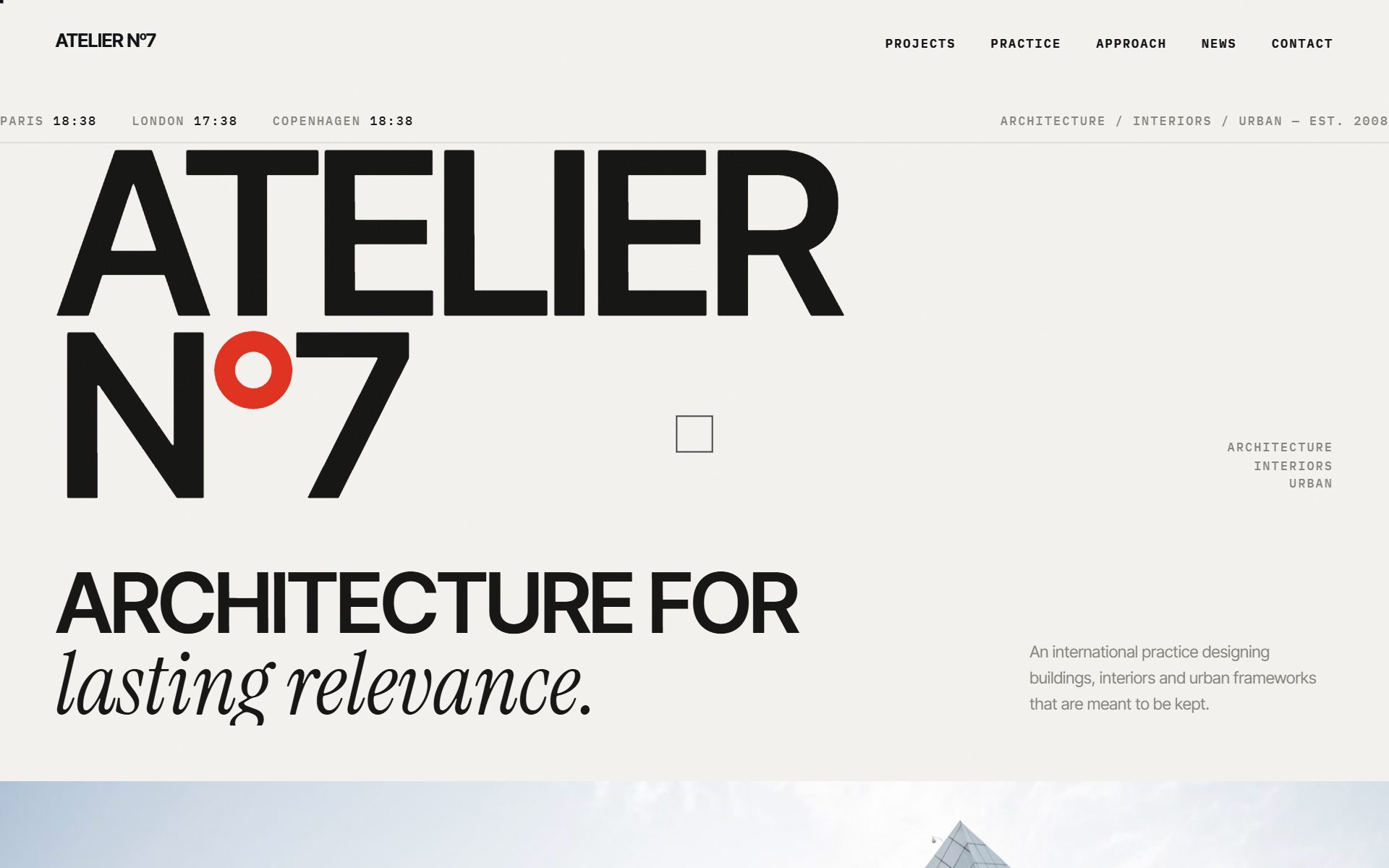
Atelier N°7
An international architecture practice given a typographic, gallery-first site - an intro sequence, a live studio clock strip and project pages that let the buildings breathe. We also built Noir House for an interiors studio, in a deliberately darker, more material-led register.
Demonstration build - the brand shown is illustrative, the design and development are ours. See our disclaimer.
Where We Would Begin.
For a design practice we begin with the portfolio itself: which projects to show, in what order, and what each one is meant to prove about how the studio thinks. That editorial decision shapes the site more than any layout choice.
Then performance, because the work is photographic and photographic sites are usually slow. Getting image delivery right early means the rest of the design can be generous with imagery instead of rationing it.
Questions We Get in This Sector.
How do we show work that is still under construction?
With progress photography, drawings and a short note on the brief. Prospective clients often find in-progress work more persuasive than a finished shot, because it shows the thinking rather than only the result.
Can you help with a practice rebrand?
We can extend an existing identity into a digital system, and we work alongside a brand designer where a full rebrand is the right move. We will tell you which one you actually need.
Can you handle very large image files?
Yes. We generate responsive sizes automatically so the visitor gets what their screen needs, not the print-resolution original.
Do you build in a CMS?
Usually, so adding projects is routine for your team. Where a practice adds two projects a year, a simpler build can be cheaper to run.
Can you help us present unbuilt work?
Yes - competitions, concepts and in-progress work are often the most interesting things a practice has, and they are usually hidden.
How many projects should the site show?
Fewer than you think. Eight to twelve strong projects, each properly told, outperforms thirty thumbnails. If a project does not represent work you want more of, it should not be on the site.
We have thousands of photographs. Can you handle that?
Yes, but curation matters more than capacity. We will work through what you have, pick the sequence that tells each project, and make sure the file sizes never punish the visitor.
Do you write the project descriptions?
We can. Usually the best result comes from interviewing the architect or designer and writing it from that, because the reasoning is already in your head and rarely in your notes.
Can the studio update the site without us?
Yes. We build so that adding a project is a routine task for someone on your team, and we hand over documentation for it rather than keeping you dependent on us.

Let’s Talk About
Your Situation.
Tell us where you are getting stuck. We will tell you honestly what we would do first - even when that is smaller than you expected.
Book a Discovery Call →